
By admin / October 14, 2026
Oct 9, 2026 · @Karun V Ajith
SEO Traffic Forecasting: How to Predict Organic Growth Without Overpromising
SEO traffic forecasting may seem simple at first. You gather your keywords, guess the rank you might achieve and calculate expected visits. In reality it feels like predicting the weather. You can make a guess, but you must be ready to adjust your plan. I began forecasting traffic for a single reason. SEO requires time. I sought a method to determine if my efforts were heading in the correct direction. A solid forecast offers expectations, a roadmap for the coming months, and a benchmark to evaluate progress.
In this guide, I will walk you through the method I use to predict website traffic, reveal a forecast where I fell short of the goal and describe where AI‑driven SEO traffic forecasting assists and where it requires human oversight.
Quick answer: SEO traffic forecasting involves estimating organic visits by combining keyword search volume, expected rankings, and click‑through rates, and then measuring the outcome against real performance each month.
What Is SEO Traffic Forecasting (and Why Bother)?
SEO traffic forecasting is the practice of estimating how organic visits a website may receive over a defined period, typically three to six months. It builds on traffic, keyword targets, and past performance as its foundation.
Here’s why it matters:
• SEO traffic forecasting sets expectations. Stakeholders stop looking for results.
• SEO traffic forecasting guides your plan. You identify which keywords merit the effort.
• SEO traffic forecasting shows whether you are on track. A difference between the forecast and reality is a signal, not a failure.
One honest warning first. SEO traffic forecasting is an estimate, not a promise. Anyone who guarantees a traffic number from SEO is overselling.
Essential Data You Need for Accurate SEO Traffic Forecasting
You don’t need software to begin. Gather these inputs first:
1. Current organic traffic from Google Search Console and Google Analytics.
2. Keyword search volume from your chosen SEO tool.
3. Current rankings for each target keyword.
4. Keyword difficulty so you can assess how competitive each term is.
5. Seasonality, because some topics peak during months.
Search Console is the reliable starting point because it displays real data from your site. Google’s documentation states that the Performance report tracks clicks, impressions, click‑through rate and average position. It also notes that position is difficult to determine, so you should rely more on impressions and clicks than on position alone. You can read the details in Google’s Performance report guide.
My Step-by-Step SEO Traffic Forecasting Process
This is the process I follow. It is simple on purpose because simple forecasts are easier to update.
Step 1: Establish Your SEO Traffic Forecasting Baseline
Open Search Console and Analytics. Record the three to six months of organic visits so you can observe the trend rather than just one month.
Step 2: Choose the Right Keywords for SEO Traffic Forecasting
Look at search volume, current ranking, and difficulty together. A keyword at position 12 with volume, is usually a better bet than a brand‑new keyword facing fierce competition.
Step 3: Estimate Ranking Improvements for Your SEO Traffic Forecast
Be conservative. Think about how your pages can realistically move over the next three to six months. Consider content quality, competition and how often you can publish or update.
Step 4: Calculate Expected Clicks Using SEO Traffic Forecasting
Multiply search volume by the expected click‑through rate, for the position you anticipate reaching. Use your Search Console CTR data where possible because it reflects your real snippets and real search results.
Here is a simple illustrative example. These numbers are fabricated to demonstrate the math:
Keyword Monthly searches Expected position Assumed CTR Estimated monthly clicks
| Keyword | Monthly searches | Expected position | Assumed CTR | Estimated monthly clicks |
| Keyword A | 2,000 | 5 | 5% | 100 |
| Keyword B | 800 | 3 | 10% | 80 |
| Keyword C | 500 | 8 | 2% | 10 |
Add the clicks across all target keywords, then add the result to your baseline.
Step 5: Build Three SEO Traffic Forecasting Scenarios
I never present one number. I build three:
• Rankings improve slowly and competitors respond.
• Rankings improve at a steady pace.
• Everything goes right including a faster ranking gain..
Step 6: Compare Actual Traffic With Your SEO Traffic Forecast
Each month place the real traffic next to the forecast. Then update the model. This step is where forecasting becomes useful because it shows you where your assumptions were wrong.
SEO Traffic Forecasting Example: When My Prediction Missed the Target
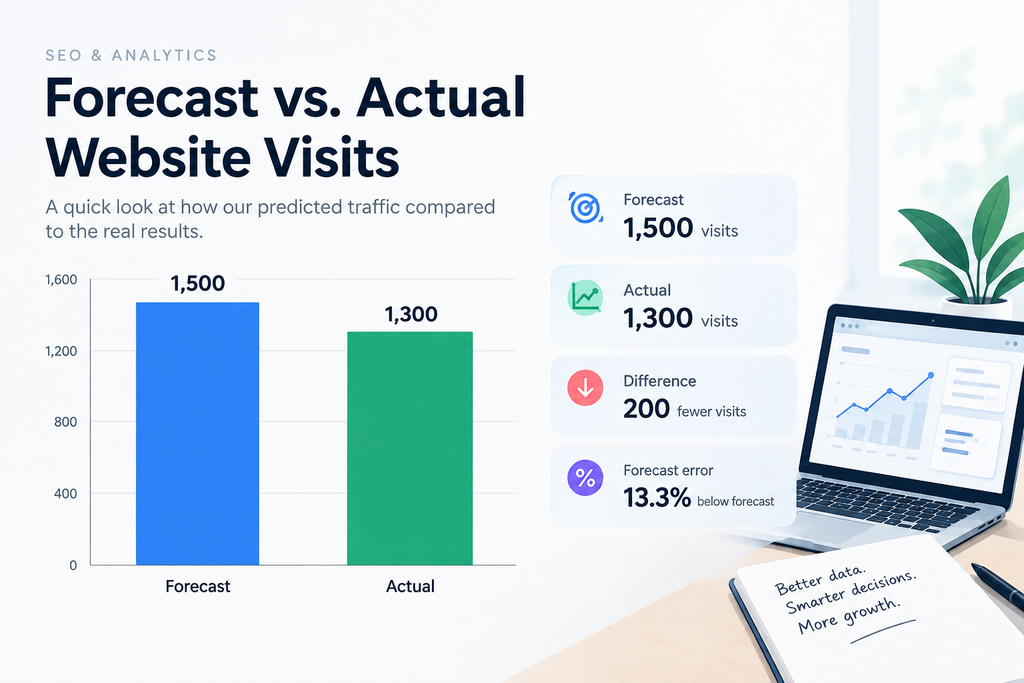
I once examined a website and estimated its organic traffic would grow from about 1,000 to 1,500 visits over three months. My logic was reasonable. Consistent content optimization and better keyword targeting should lift rankings gradually.
The result was 1,300 monthly visits. That was 200 visits below my target or roughly 13% lower than predicted.
Traffic still grew by 30% so the work was clearly helping. The miss taught me three things:
• Rankings moved slower than I assumed. Pages do not always climb on schedule.
• Competition mattered more than the tool suggested. Keyword difficulty scores are a guide, not a rule.
• A single forecast number is fragile. If I had shown a range with a case where 1,300 visits would have looked like a solid result and not a shortfall.
That experience is the reason I now build three scenarios and review them every month.
Common SEO Traffic Forecasting Mistakes to Avoid
I see these often. I’ve made a few myself:
• • Using one optimistic ranking guess for every keyword.
Ignoring seasonality, then blaming SEO when a slow month arrives.
• Treating CTR as fixed. Click-through rates change with the search results page.
• Never checking the forecast against reality.
That third point deserves attention. Search results now carry AI-generated summaries on queries. One study by Ahrefs as summarized in this CTR benchmark roundup found that AI Overviews were linked to a click-through drop of 58% for top-ranking pages. Studies vary widely. Position 1 CTR estimates range from about 19% to nearly 40% depending on the study and the query type. So treat any published CTR table as a guide and trust your own Search Console numbers more.
How AI-Powered SEO Traffic Forecasting Helps Predict Organic Growth
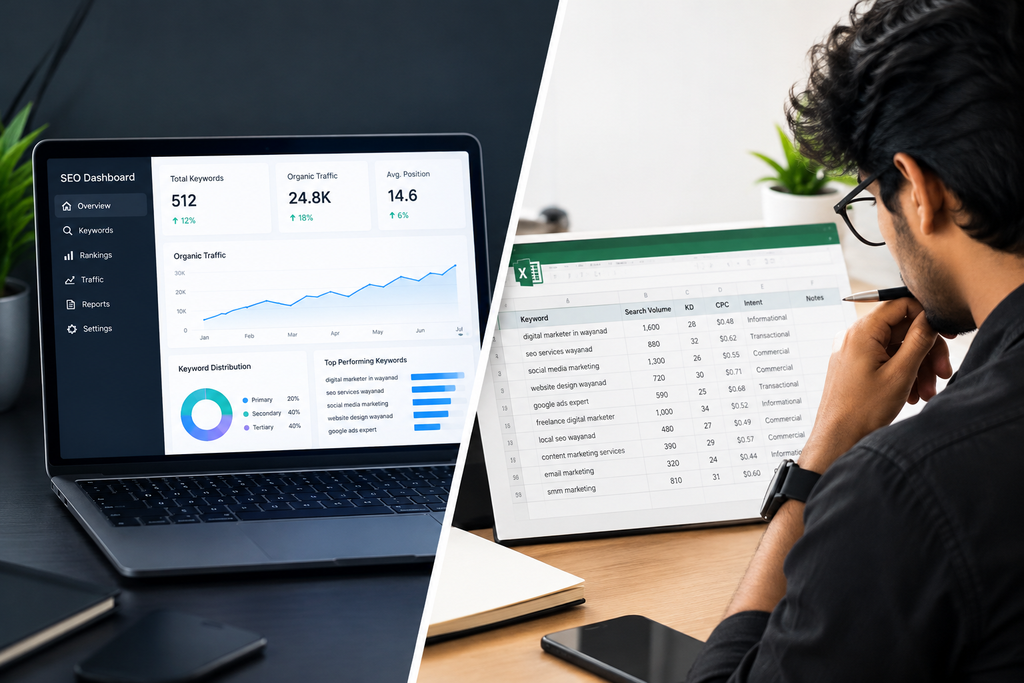
AI-powered SEO forecasting has become a part of my workflow. Used well, it saves time. Used blindly, it can mislead you.
AI-powered forecasting Manual analysis
Speed Fast Slow
Scenario comparison Easy to run many Time-consuming
Pattern spotting Finds trends you might miss Depends on your eye
Algorithm updates Often blind to sudden changes You can react with context
Business context Limited Strong
Search intent shifts Can lag behind You can spot them early
My view is simple. AI tools are only as reliable as the data you provide. They cannot fully understand an algorithm update, a competitor’s new campaign or the unique situation of a business.
So here is how I use them:
1. Let AI analyze the data and draft a forecast.
2. Review every assumption myself.
3. Adjust for real-world factors the tool can’t see.
4. Compare the result with traffic each month.
AI supports my judgment. It does not replace it.
Practical Tips for More Accurate SEO Traffic Forecasting
• Start from your own Search Console data, not generic benchmarks.
• Forecast for three to six months, not twelve. Accuracy drops with time.
• Weight your forecast toward keywords you already rank for.
• Always show a range, never a number.
• Write down your assumptions so you can learn from the gap later.
Frequently Asked Questions About SEO Traffic Forecasting
How accurate is SEO traffic forecasting?
It is an estimate. In my example the forecast was 13%, above actual traffic. Accuracy improves when you use data, build scenarios and update monthly.
How ahead should I forecast?
Three to six months is the range for SEO traffic forecasting. Beyond that, many variables change.
Can I predict website traffic for a site using SEO traffic forecasting?
You can estimate potential from keyword volume and competition. With no history the uncertainty is high. Use ranges.
Do I need AI tools for SEO traffic forecasting?
No. A spreadsheet and Search Console data are enough to start. AI tools speed things up and help compare scenarios.
SEO traffic forecasting will not give you numbers and it should not. Its real value is planning, honest expectations and a monthly habit of learning from the gap between prediction and result.
Your action plan:
1. Pull your baseline from Search Console and Analytics.
2. Choose keywords with potential.
3. Build realistic and optimistic scenarios.
4. Use AI to speed up the analysis, then review it yourself.
5. Compare traffic to your forecast every month and adjust.
Start small, stay honest about uncertainty and let your own data make each forecast better than the last.
Conclusion: Build a More Reliable SEO Traffic Forecasting Strategy
SEO traffic forecasting is not about predicting exact numbers or promising overnight results. It is about using real data, setting realistic expectations, and making informed decisions to improve organic growth over time. By analysing keyword search volume, current rankings, click-through rates, and historical website traffic, you can build a practical forecast that supports your SEO strategy.
As I learned from my own forecasting experience, actual results may differ from predictions. That is why I recommend building conservative, realistic, and optimistic scenarios instead of relying on a single traffic target. Regularly comparing your forecast with actual performance also helps you identify gaps, refine your assumptions, and improve future predictions.
AI-powered SEO traffic forecasting can make data analysis and scenario planning faster, but human judgement remains essential. Search algorithm updates, changing search intent, competition, and AI Overviews can all influence organic traffic in ways that tools may not fully anticipate.
If you are starting your SEO journey, begin with Google Search Console and Google Analytics, choose keywords with realistic ranking potential, and review your progress every month. You do not need an expensive tool or a perfect prediction to get started. You need a consistent process, reliable data, and a willingness to learn from the results.
As a freelance digital marketer in Alappuzha, I believe that sustainable digital growth starts with data-driven decisions, realistic goals, and continuous optimization. Through my portfolio website I share my digital marketing knowledge, SEO insights, and practical approaches to helping businesses strengthen their online presence.